

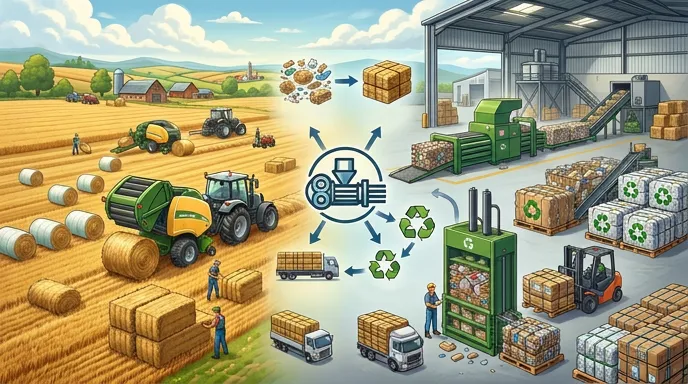
In today's industrial landscape, efficient waste management is not just a regulatory requirement but a cornerstone of sustainable and cost-effective operations. At the heart of this efficiency lies the baler press, an indispensable piece of machinery that transforms loose waste into compact, manageable bales. But what exactly is a baler press, what varieties exist, where are they used, and what benefits do they offer? Let's delve into this crucial industrial equipment.
What is a Baler Press?
A baler press, often simply referred to as a baling machine or compactor, is an industrial device designed to compress various types of loose materials into dense, uniform bales. These materials can range from cardboard, paper, and plastic to textiles, metal scrap, and even agricultural waste. The primary purpose of baling is to significantly reduce the volume of waste, thereby optimizing storage space, simplifying transportation, and preparing materials for recycling or disposal.
The process typically involves loading material into a chamber, where a hydraulic ram applies immense pressure to compress it. Once compressed to a desired density, the material is then secured with wires, straps, or netting, forming a solid bale that retains its shape.
The Evolution of Waste Management with Baler Presses
Historically, waste handling was a labor-intensive and space-consuming process. The introduction of baler presses revolutionized this by allowing businesses to process larger volumes of waste more quickly and efficiently. This not only reduced operational costs but also played a pivotal role in making recycling economically viable and widespread.
Types of Baler Presses
Baler presses come in various configurations, each suited for different materials, volumes, and operational needs. The two most common types are vertical and horizontal balers.
Vertical Baler Presses
- Description: Vertical balers are typically smaller in footprint, making them ideal for businesses with limited space. Material is loaded from the top, and a hydraulic ram compresses it downwards. Once the bale is formed, it's manually tied off and ejected.
- Suitable Materials: Excellent for cardboard, plastic film, paper, textiles, and some non-ferrous metals.
- Usage Areas: Supermarkets, retail stores, hotels, small manufacturing plants, and offices.
- Advantages: Cost-effective, compact design, easy to operate.
Horizontal Baler Presses
- Description: Horizontal balers are designed for higher volume processing. Material is fed horizontally into the chamber, often automatically via a conveyor belt, and compressed by a horizontal ram. They can be manual-tie or automatic-tie, with automatic models capable of continuous operation.
- Suitable Materials: Ideal for large quantities of cardboard, paper, plastics (PET, HDPE), aluminum cans, and even some municipal solid waste.
- Usage Areas: Large recycling facilities, distribution centers, large manufacturing operations, printing houses, and waste management companies.
- Advantages: High throughput, greater automation, larger bale sizes, continuous operation.
Other Specialized Baler Types
- Closed-End Horizontal Balers: A hybrid, offering higher capacity than vertical balers but less automation than open-end horizontal balers.
- Two-Ram Balers: Highly robust machines for extremely high volumes and challenging materials, including metals and municipal solid waste.
- Semi-Automatic & Fully Automatic Balers: Refer to the level of human intervention required for tying and ejection, with fully automatic offering continuous, unattended operation.
Common Usage Areas of Baler Presses
The versatility of baler presses makes them indispensable across a wide range of industries:
- Recycling Facilities: The cornerstone of their operations, processing vast quantities of paper, plastic, and metal for resale.
- Manufacturing Plants: Compacting production waste like off-cuts, packaging, and scrap materials.
- Retail & Distribution Centers: Managing cardboard boxes, plastic packaging, and shrink wrap from incoming goods.
- Warehouses: Reducing the volume of packaging waste generated during storage and shipping.
- Printing Houses: Baling paper waste, trimmings, and off-cuts.
- Hotels & Restaurants: Compacting cardboard and plastic packaging.
- Agriculture: Baling hay, straw, and other crop residues (though often with specialized agricultural balers).
At Kamaksan Makina | Yatay ve Dikey Balya Pres Makineleri, we understand the critical role these machines play in various sectors, offering tailored solutions to meet specific industry demands.
Key Benefits of Using a Baler Press
Investing in a baler press offers a multitude of advantages that extend beyond mere waste disposal:
- Space Optimization: By compressing waste into dense bales, balers drastically reduce the volume of material, freeing up valuable floor space that would otherwise be consumed by loose waste.
- Cost Reduction:
- Lower Transportation Costs: Fewer trips are needed by waste haulers, as more material can be transported per load.
- Reduced Storage Costs: Less space means lower overheads for waste storage areas.
- Increased Revenue: Baled recyclables often fetch higher prices from recycling companies compared to loose materials, turning waste into a revenue stream.
- Environmental Impact: Encourages and facilitates recycling, diverting significant amounts of waste from landfills and reducing the carbon footprint associated with waste transportation.
- Improved Safety & Hygiene: Baled waste is tidier, reduces fire hazards, and creates a cleaner, safer work environment by minimizing clutter and pest attraction.
- Enhanced Operational Efficiency: Streamlines the waste handling process, saving labor time and allowing employees to focus on core business activities.
- Compliance: Helps businesses comply with environmental regulations and waste management policies.
Choosing the right baler press for your operations can significantly impact your bottom line and environmental performance. Kamaksan Makina offers a comprehensive range of baling solutions, from robust vertical balers to high-capacity horizontal balers, ensuring you find the perfect fit for your industrial needs.
Conclusion
Baler presses are more than just waste compactors; they are essential tools for modern businesses committed to efficiency, sustainability, and cost control. By understanding their types, applications, and profound benefits, businesses can make informed decisions that lead to cleaner operations, reduced expenses, and a positive environmental impact. Whether you're a small retail outlet or a large industrial plant, a baler press is an investment that pays dividends in operational excellence and environmental stewardship.